Anti-glare window film for Augusta offices reduces harsh daylight and screen reflections while keeping useful natural light in the workspace. It helps employees see monitors more comfortably without relying on closed blinds or overly bright screens.
That matters because sunlight can quickly turn a bright office into a frustrating workspace. Glare on computer monitors, conference-room displays, and reception screens can make everyday tasks harder.
At Dark Side Window Tinting, we see this often across Augusta and the CSRA. We evaluate the glass, sun exposure, and screen placement to recommend anti-glare window film for Augusta offices that improves comfort without making the space feel too dark.
Why Do Augusta Offices Get So Much Screen Glare?

Screen glare happens when the brightness around a computer display becomes difficult to balance with the screen itself.
Sometimes sunlight reflects directly off the monitor. In other situations, a bright window sits behind or beside the screen, creating a sharp contrast between the display and the surrounding area.
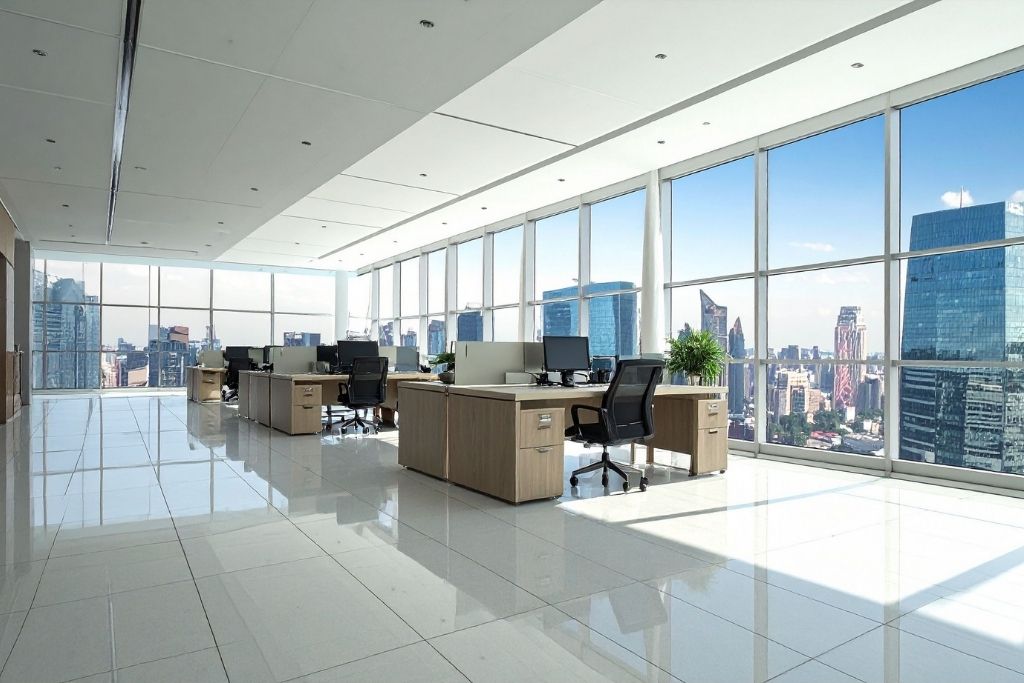
Augusta’s strong sunlight can make this especially noticeable in offices with:
- large exterior windows;
- east- or west-facing glass;
- desks positioned close to windows;
- conference rooms with wall-mounted displays;
- reception areas with computer screens; and
- open offices where employees cannot easily reposition workstations.
From our experience, timing matters as much as window size. A workspace that feels perfectly comfortable in the morning can become difficult to use in the afternoon.
That is why we do not evaluate office window film in Augusta by looking at the glass alone. We want to understand when the problem occurs and how people actually use the space.
Why Does Sunlight Make Computer Monitors Hard to See?
A bright window can create direct glare in an employee’s field of view or produce reflections on the monitor itself.
The employee may respond by increasing screen brightness, leaning forward, changing the monitor angle, moving a chair, or closing the blinds.
Those workarounds may help temporarily, but they do not change the amount of daylight coming through the glass.
With properly selected window film for computer screen glare, we can reduce excessive brightness before it reaches the workstation.
How Does Anti-Glare Window Film Work in an Office?
Anti-glare window film for Augusta offices works by reducing a portion of the visible light entering through the glass. Depending on the film selected, it may also help manage solar heat, UV exposure, and reflectivity.
The important point is that glare reduction does not have to mean turning a bright office into a dark room.
When we recommend an architectural window tinting solution for an Augusta business, we consider how much daylight the space should retain along with the amount of glare that needs to be controlled.
The goal is balance.
For example, a conference room used for presentations may need stronger glare control than a lobby where maintaining a bright, open appearance is the bigger priority.
That is one reason we avoid treating all commercial windows the same.
Can Window Film Reduce Screen Glare Without Blocking Natural Light?
Yes. That is one of the main reasons businesses consider anti-glare window film for Augusta offices.
Film does not have to eliminate daylight. Instead, the right product can moderate excessive brightness while allowing useful natural light to remain.
We often explain it this way: you are not trying to remove the window from the room. You are trying to make the light coming through it easier to live and work with.
That difference matters in offices where people value outdoor views and daylight but are tired of fighting reflections on their screens.
Why Is Visible Light Transmission Important?
Visible light transmission, commonly called VLT, is one of the specifications we consider when evaluating commercial anti-glare window film.
In simple terms, VLT describes how much visible light passes through the glass and film.
A film that allows more visible light generally creates a brighter interior appearance. A film that allows less visible light can provide stronger brightness control.
But darker is not automatically better.
That is an important point we make with customers.
If the film reduces more daylight than the office actually needs, the workspace may end up feeling unnecessarily dim. On the other hand, choosing a very light film for a window receiving intense direct sun may not provide enough glare reduction for nearby screens.
When selecting anti-glare window film for Augusta offices, we look at factors such as:
- window orientation;
- existing glass construction;
- direct sun exposure;
- desk and monitor location;
- desired exterior appearance;
- privacy preferences;
- existing blinds or shades; and
- how much natural daylight the business wants to preserve.
The right film is the one that solves the actual problem while fitting the space.
What Type of Anti-Glare Window Film Is Best for an Augusta Office?
There is no single answer that works for every building.
Different architectural films offer different combinations of visible light transmission, glare reduction, solar heat rejection, UV protection, and window reflectivity.
Neutral Solar-Control Film
Neutral films can be useful when a business wants glare and solar control without dramatically changing the appearance of the windows.
For professional offices where maintaining a subtle, uniform look matters, this type of film may be worth considering.
Dual-Reflective Film
Dual-reflective films can provide stronger solar control while using different levels of reflectivity on the exterior and interior surfaces.
They may make sense for highly sun-exposed glass where both glare and solar heat are concerns.
We also discuss appearance expectations before recommending reflective products because lighting conditions can affect how the glass looks from inside and outside.
Ceramic and Other High-Performance Films
Ceramic and other advanced solar-control technologies can provide another option for offices that want strong performance while maintaining a lighter or less reflective appearance.
We use premium LLumar architectural products and select films according to the needs of the property rather than assuming one technology is best for every customer.
If you want to see examples of our finished work, you can browse our window tinting and architectural film gallery.
What Are the Benefits of Anti-Glare Window Film Beyond Screen Visibility?
The primary reason for installing anti-glare window film for Augusta offices may be screen glare, but a properly selected solar-control film can provide additional benefits.
More Comfortable Work Areas Near Windows
Sun-exposed desks can feel noticeably different from workstations farther inside the building.
Solar-control film can help manage part of the solar energy entering through the glass, which may improve comfort near exterior windows.
We cover this issue in more detail in our guide to commercial window film for Augusta businesses during peak summer heat.
Reduced UV Exposure
Many architectural films also reduce ultraviolet transmission.
That can help limit one contributor to fading affecting flooring, furnishings, artwork, displays, and other interior materials.
We keep expectations realistic here. UV exposure is only one factor involved in fading. Heat, visible light, material composition, and other environmental conditions also contribute.
More Consistent Daylight Control
Blinds are useful, but employees have to adjust them.
Window film works continuously once installed. That can provide more consistent daylight control in offices where glare appears at predictable times every day.
How Do We Evaluate Screen Glare Before Recommending Film?
One of the most useful things a business owner can do is observe the office throughout the day before deciding on a film.
We want to know:
- What time does the glare become noticeable?
- Which windows are involved?
- Which desks or displays are affected?
- Do employees routinely close the blinds?
- Is heat also a concern?
- Does glare affect customers or only staff?
- Is preserving exterior appearance important?
A simple walkthrough can reveal a lot.
Sometimes monitor repositioning can solve part of the problem. Sometimes the window exposure is clearly the larger issue. Often, both can be improved.
That is the kind of practical guidance we prefer to give. Installing film where it is not needed does not benefit the customer.
How Do You Maintain Office Window Film?
Maintenance is usually straightforward.
Once the film has cured according to the installation guidance provided for the product, treated windows can typically be cleaned with gentle methods.
We recommend avoiding aggressive scrubbing, abrasive cleaning materials, and sharp tools that could scratch or damage the film surface.
Soft cloths or microfiber materials are a better choice for routine cleaning.
If your janitorial team or building maintenance company handles the windows, let them know film has been installed so they can use appropriate cleaning practices.
If you are unsure how to care for a particular installation, contact our Augusta window tinting team and we can help.
Is Anti-Glare Film the Same as Security Window Film?

No. This distinction matters.
Solar-control and anti-glare films are primarily chosen for managing sunlight, screen glare, solar heat, UV exposure, and appearance.
Safety and security films are engineered around glass retention and impact-related concerns.
If your business is also evaluating protection for storefront or office glass, read our guide to security window film for Augusta storefronts and offices.
For property owners thinking about weather-related glass risks, we also explain how safety and security window film can help during storm season.
Some projects may involve multiple performance goals, but we do not assume one film automatically handles everything.
Why Work With Our Dark Side Window Tinting Team?
We have been serving Augusta since 1986.
Dark Side Window Tinting is a third-generation, family-driven business and part of T Banks Window Tinting. Over the years, our work has expanded across automotive window tint, paint protection film, and architectural film installations for homes and commercial properties.
What has not changed is how we approach the job.
We ask questions first.
For anti-glare window film for Augusta offices, that means understanding when glare occurs, what employees are experiencing, what type of glass is present, how much daylight you want to keep, and what you want the finished windows to look like.
We use premium LLumar products and focus on careful film selection and precision installation.
You can learn more about our Augusta window tinting team and experience or review our architectural tinting services for homes and businesses.
Reduce Screen Glare Without Giving Up Your Augusta Office's Natural Light
When employees are closing the blinds every afternoon just to read their monitors, it is worth addressing the light at the window.
The right anti-glare window film for Augusta offices can reduce screen glare, preserve useful natural daylight, improve comfort near sun-exposed glass, and provide additional solar-control benefits depending on the product.
At Dark Side Window Tinting, we would rather recommend the right film, or tell you when another adjustment makes more sense, than simply sell the darkest option.
If your Augusta, Martinez, Evans, or nearby CSRA office is dealing with computer glare, we can look at the glass, sunlight, room layout, and your priorities before recommending a solution.
Request a quote for architectural window film or contact our Augusta team to talk through what is happening in your workspace.
Dark Side Window Tinting - Tint & Paint Protection Film
 (90) Window tinting services
Address
108 Prince Dr, Augusta, GA 30907, United States
Phone:
+17068556004
Google Review
All Google Reviews